

Cheat on your partner
Seriously, do it.

There’s a popular meme song in India
“Apne lover ko dhokha do, darling humein bhi mauka do”
[cheat on your lover and give me a chance, darling]
It’s quite catchy. My non-Indian readers will be dancing to its tunes, too.
But this post isn’t about catchy Indian songs, their memes, or even their lyrics. It’s about the effect of the media we consume on our behaviours and thoughts.
→ If I told you to cheat on your partner, would you?
Maybe, but probably not.
→ If I told you to cheat on your partner 100 times, would you?
Probably not.
→ If I told you that you’d never get caught even if you did it, would it make you start a search for the lover that was promised?
Probably not.
What would it take for me, the media, to change thoughts, emotions, and behaviours in you, the consumer? There’s a whole field of media psychology dedicated to answering this question.

Video Games, Rap Music, Action Movies, and Clutching Pearls
When I was growing up [in the 2000s - I am not that old], there was concern in the media that listening to rap music, playing video games, or watching movies that glorify drugs, guns, and gangsters could hurt young children.
If children played violent games like GTA Vice City or GTA San Andreas, they would grow up to become violent thugs. If they watched WWE, they would start wrestling with the first person they saw on the street.
Children, after all, are no different than monkeys. Monkey see, monkey do.
My mom, being the protective mom she is, ensured I watched no wrestling, didn’t play GTA games, and only grew up listening to Parent-approved music.
But can anything break the spirit of rebellion in a teenage heart?
I grew up listening to Eminem, playing violent video games, and watching action movies.
Obviously, I turned into a drug addict who doesn’t wear anything but baggy clothes and engages in criminal activities.
The truth is that the effect of media on individual psychology is a lot more complicated than simply consuming/not consuming a piece of media.
The effect of what we consume is strongly moderated by the family environment and peer network we grew up in, along with our own personality and temperament.
Cheat on your partner, DO IT!
When I tell you to cheat on your partner, the first thing you do is laugh it off.
The idea is inconceivable to you. You love your partner. You know cheating is wrong.
→ How do you know cheating is a moral wrong?
You learned it from your parents.
You were taught that honesty is the best policy, that we must not hurt others, and that we must not be selfish. All these things were demonstrated to you in your formative years. They became a core part of who you are.
Moreover, you have seen what it is like to be cheated on. Maybe your friend was cheated on. You saw how broken they were. You know the hurt something like this can bring.
And so, you don’t cheat on your partner. No matter how much I, or any song, tells you to.
That is precisely what media psychology has discovered about the role of violent media on individual behaviour as well!
What does the research say?
This 2019 study tried to understand the mediating/moderating effect of family environment on children’s normative beliefs about aggression. Essentially, they sought to determine whether the type of family environment you come from influences your perception of aggression as a normal response to circumstances.
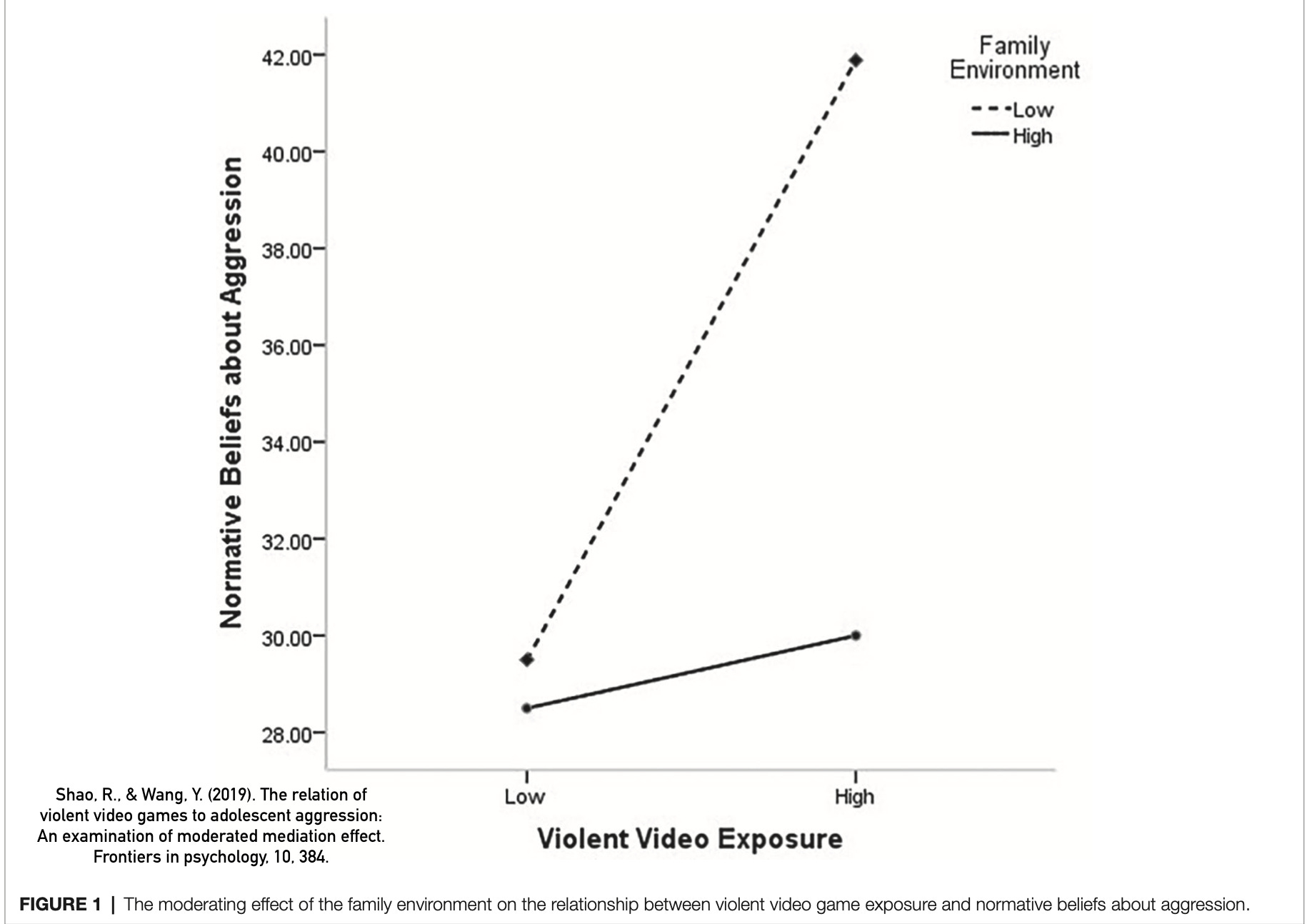
High exposure to violent videos increases normative beliefs about aggression in adolescents. How much increase there is is strongly mediated by the family environment one grew up in.
Adolescents who grew up in family environments characterized by mutual trust, support, and minimal aggression, with a strong emphasis on morals and values, are less likely to believe that aggression is a normal response to circumstances, even if they have high exposure to violent videos.
Contextualize, don’t restrict
An instinctual, protective response among parents is to restrict their child from accessing any violent media. This strategy is self-defeating.
While a pre-adolescent might respect everything a parent tells them, adolescence is marked by a sense of rebellion. Complete restriction of any kind of violent media makes the child think something is being hidden from them. Much like the forbidden fruit, the child experiences increased temptation to consume such media away from the watch of the parents.
A much better approach, as noted by Nathanson (1999), is to contextualize the media, explain the negative effects of violence in the real world, and help a child separate reality from fiction.
Watching the media without any feedback signals implicit approval. Restricting the media completely creates temptation. The mediation route seems like the safest route to take
Cheat on your partners, your friends already do it
Another important role on the long road between media and the individual is played by the peers they’re surrounded by.
If you are surrounded by friends or peers who engage in violent behaviour, who have violent tendencies, or approve of violence as a way to resolve problems, the chances of you engaging in violence go up as well.
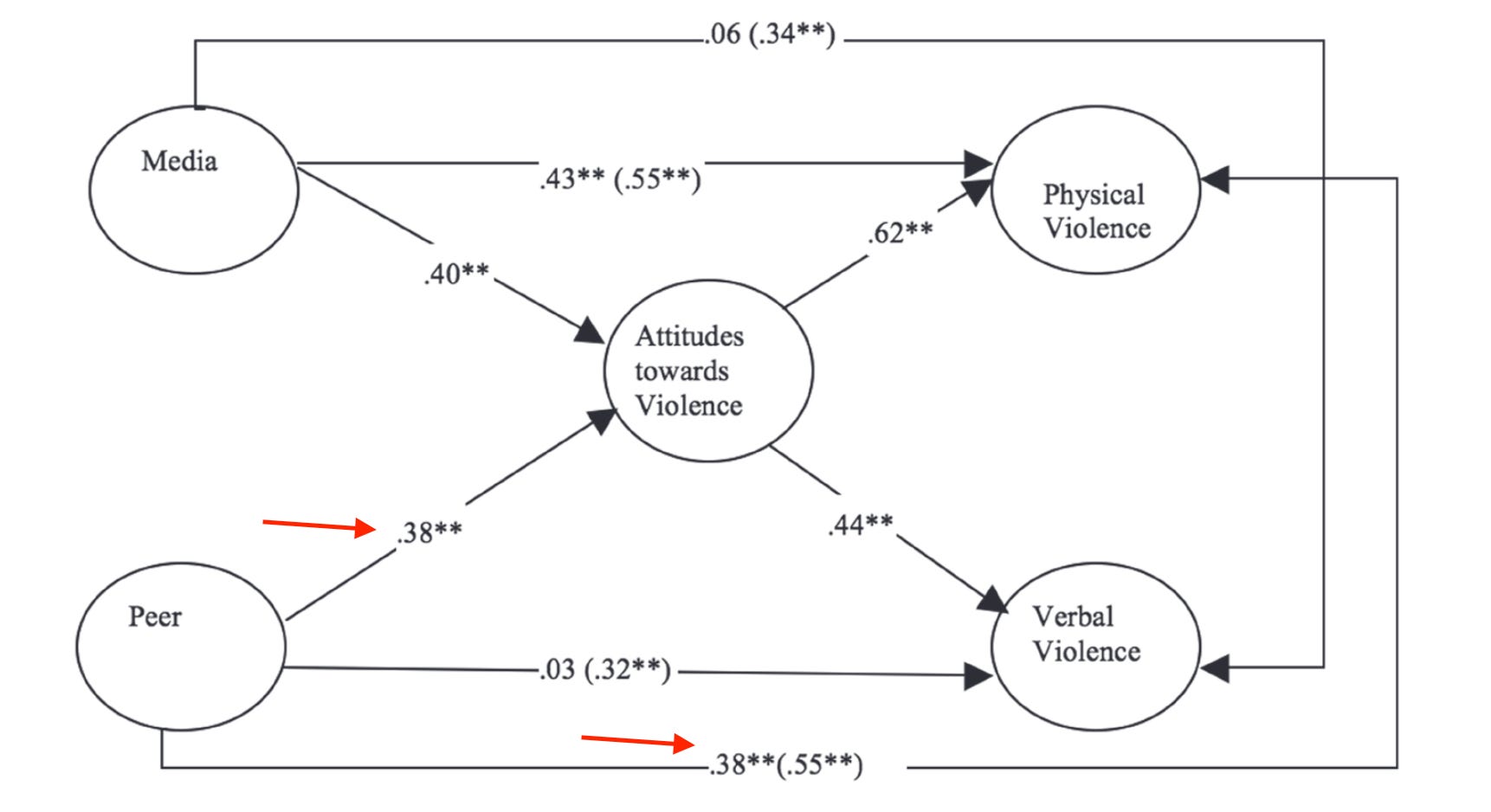
Here’s a SEM analysis of the role of peer and media on attitudes towards violence and eventual physical/verbal violence. The study was conducted on teenagers, and when the role of inter-parental conflict was assessed, it had little to no predictive power on eventual violent behaviour.
This suggests that as children grow older, the role of their parents reduces and peer influence grows rapidly. Interestingly, this aligns with what we expect from the psycho-social stages of development according to Erikson.
Actually, don’t cheat on your partner
As a creator, this article can be a get-out-of-jail-free card. Whenever something goes wrong, I can simply point to the role of parenting and peers on individual behaviour, and simply escape any accountability for my actions.
If my encouragement to “cheat on your partner” won’t change your mind, does that mean I should keep saying it as much as I like without any repercussions?
I don’t think so.
As a creator myself, I am responsible for the content I produce for my community. If I glorify self-destructive habits, most people will not change their behaviour at all, but there will always be someone.
One person who is the perfect mix of a violent home environment, peers that encourage violence, and an environment where violence is the norm. This person is on the brink of a violent act. Should I be the one to push them over the edge?
That’s not what I want to do.
If anything, I want to bring them back from the brink and help them understand that we are not simply a product of our environment, that we can be much more than what we are destined to be, much more than what we are surrounded by.
It’s not that simple to shrug away any and all responsibility of the work we put out
Human see, human do?
“Monkey see, monkey do” is an old adage. Thankfully, we humans are more complicated than that.
Human see,
Human think about it, understand the consequences, compare it to normative beliefs, measure it up against prevalent attitudes and maybe do.
It is a nice read. Keep writing. One day I will earn enough money as a psychologist and pledge support to your work.
I loved this. My father used to be very against me playing PUBG because it would make me violent as well—I was simply using it as a tool to channel my emotions.
Blaming media for our actions is so redundant. Yes, it plays a role but our society plays a far bigger role. Because when an objectionable piece of media makes a round, there are supporters and critics. The critics are watching the same thing yet somehow have a completely different response to it.